What is Minicomputer? Exploring Its Role in Modern Tech
Published: 13 Dec 2025
You may have heard the word “minicomputer” and wondered what it actually means.It’s easy to get confused, especially with all the different types of computers out there. But don’t worry, we’ll explain everything in this guide. We’ll explore how minicomputers differ from other types of computers, their key features, and how they’ve evolved over time. By the end, you’ll have a clear understanding of ‘what is minicomputer’ and how it fits into the modern tech landscape.
What is Minicomputer?
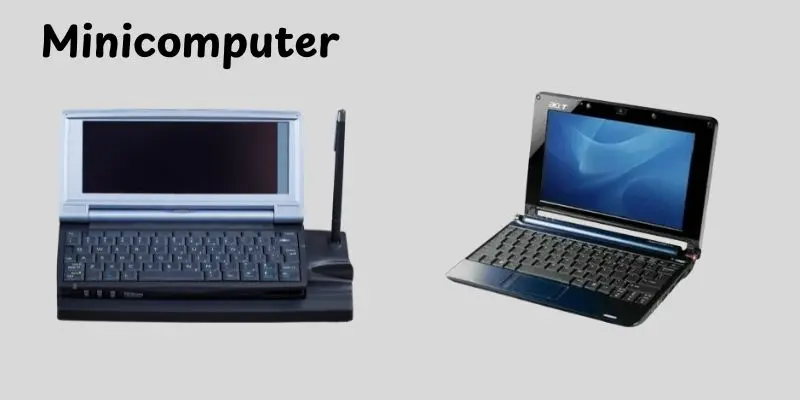
A minicomputer is a type of computer that is more powerful than a microcomputer but smaller and less powerful than a mainframe. It was designed to handle multiple users at once, making it ideal for business or research environments. Unlike personal computers, minicomputers are capable of managing complex tasks and running more advanced software. They became popular in the 1960s and 1970s as a cost-effective solution for medium-sized businesses and institutions. Though they are less common today, their influence can still be seen in modern servers and mid-sized computing systems.
Evolution & History
The minicomputer has an intriguing history, driven by technological progress and the evolving demands of businesses and research.Let’s take a look at how it evolved and why it became a game-changer in computing.
- In the 1960s, the development of integrated circuits made it possible to create smaller and more affordable computers.
- Minicomputers bridged the gap between large, expensive mainframes and personal computers.
- They were popular in businesses, universities, and laboratories for running complex tasks at a lower cost.
- The rise of minicomputers led to innovations in operating systems, networking, and multi-user computing.
- While modern technology has moved beyond them, minicomputers helped lay the foundation for today’s server and cloud computing systems.
Core Features of Minicomputer
They have several key features that make them unique and well-suited for specific tasks. Here’s a look at the main characteristics:
- Size and Portability: Minicomputers are smaller than mainframes but larger than personal computers, making them easier to fit into office or research environments.
- Multi-User Capability: They can handle multiple users simultaneously, making them ideal for environments where several people need access to computing resources at the same time.
- Processing Power: While not as powerful as mainframes or supercomputers, minicomputers offer solid performance for business, research, and industrial tasks.
- Cost-Effectiveness: Minicomputers were more affordable than mainframes, providing businesses and universities with a more budget-friendly option for powerful computing.
- Scalability: Many minicomputers can be expanded with additional memory or storage as needed, allowing for growth without replacing the entire system.
- Reliability: These systems are known for being durable and dependable, with high uptime in industrial or business settings.
How Minicomputers Work (Step‑by‑Step)
Minicomputers are designed to process data, manage tasks, and serve multiple users simultaneously. Here’s how they work in simple terms:
- Input: Users provide data or commands through devices like keyboards, mice, or other input devices.
- Processing: The minicomputer’s central processing unit (CPU) takes this input and performs calculations or operations.
- Memory: Data is temporarily stored in the computer’s memory, allowing quick access while tasks are being processed.
- Multi-Tasking: Minicomputers can handle several tasks or users at once, switching between them quickly without slowing down.
- Output: After processing, results are sent to output devices, like monitors or printers, for users to view or use.
- Storage: Data can be saved on storage devices, such as hard drives, for long-term use.
Examples of Minicomputers
Minicomputers have played a significant role in the development of modern computing, with several iconic models shaping the industry. Here are some key examples of minicomputers, both from the past and present:
- DEC PDP-8: One of the first commercially successful minicomputers, released in 1965, which made computing more affordable for small businesses and research institutions.
- DEC PDP-11: Introduced in 1970, this system was highly flexible and widely used for scientific and business applications, influencing early software development.
- VAX Systems: Launched in the late 1970s, the VAX series offered high performance and became a staple in academic and business environments for decades.
- IBM AS/400 (Now IBM iSeries): A minicomputer designed for business use, launched in 1988, which continues to be used today for enterprise-level applications.
- HP 3000: A popular choice for businesses in the 1970s and 1980s, the HP 3000 was designed for running database and business management applications.
- Raspberry Pi: A modern, low-cost, compact computer that shares many features with traditional minicomputers, widely used in education and hobbyist projects.
- Sun Microsystems SPARCstations: High-performance workstations from the late 1980s and early 1990s, used in scientific and engineering applications with networked computing capabilities.
Types of Minicomputer
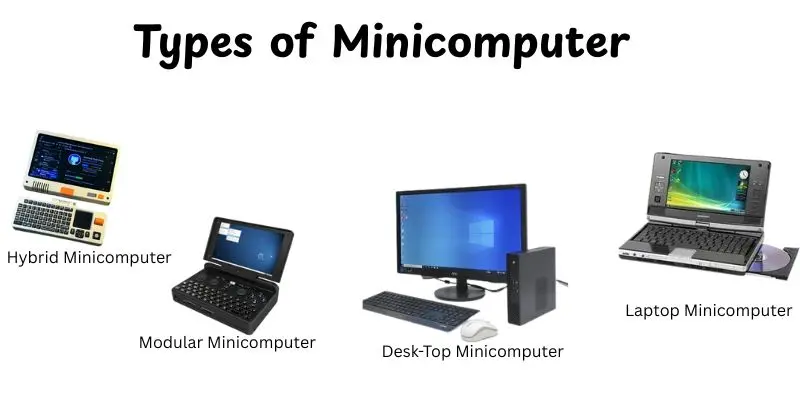
Minicomputers come in different types, each designed to meet specific needs in business, research, or industrial environments. These types vary in performance, size, and their ability to handle multiple users. Here are some of the main types of minicomputers:
- Desk-Top Minicomputers: These are compact, often placed on a desk, and used for smaller business or office environments. They are easy to manage and don’t take up much space.
- Rack-Mounted Minicomputers: Designed to be mounted in a rack, these are typically used in data centers or environments requiring more power and scalability. They can support larger systems and more users.
- Modular Minicomputers: These systems are built with interchangeable parts, allowing businesses to upgrade or expand the system as needed.They are versatile and can be tailored to suit specific needs.
- Hybrid Minicomputers: Combining features of both minicomputers and mainframes, hybrid minicomputers can handle more intensive tasks while still being more affordable and smaller than traditional mainframes.
Common Uses of Minicomputers Today
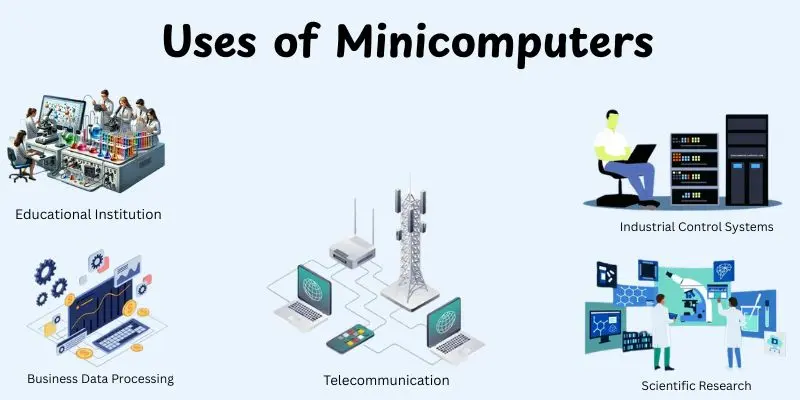
Minicomputers have found a wide range of applications in various fields due to their ability to handle multiple tasks and users efficiently. While they were once the go-to solution for businesses and institutions, many of their functions continue to be important in today’s tech landscape. Here are some key areas where minicomputers are used:
- Business Data Processing: Minicomputers are used by small to medium-sized businesses for managing accounting, inventory, and customer databases.
- Industrial Control Systems: They manage machinery and production lines in factories, ensuring smooth operations and real-time monitoring.
- Scientific Research: Researchers use minicomputers for processing large data sets, running simulations, and controlling laboratory equipment.
- Healthcare: In hospitals and medical facilities, minicomputers are used for patient management systems and medical data analysis.
- Educational Institutions: Universities and schools use minicomputers for research, managing student records, and providing shared computing resources.
- Telecommunications: Minicomputers are involved in managing communication systems, including phone networks and data transmission.
- Point of Sale (POS) Systems: Many retail businesses use minicomputers for transaction processing and inventory management at checkout counters.
- Embedded Systems: In embedded systems, minicomputers control and monitor devices like vending machines, security systems, and consumer electronics.
- Network Management: They are used in managing and monitoring local area networks (LANs), handling traffic, and ensuring security.
Advantages and disadvantages of Minicomputers
Minicomputers offer a mix of benefits and limitations depending on the use case. While they provide certain advantages for specific applications, there are also some drawbacks to consider. Here’s a quick look at the pros and cons:
| Advantages of Minicomputers |
|---|
|
| Disadvantages of Minicomputers |
|---|
|
Advancements in Minicomputer Technology
Minicomputers have evolved significantly over the years, with advancements in performance, efficiency, and versatility. These improvements have allowed them to remain relevant in modern tech, adapting to new challenges and industries.Here’s an overview of some key advancements:
- Smaller Form Factors: Over time, minicomputers have become more compact, making them easier to integrate into smaller spaces and reducing the physical footprint in data centers and offices.
- Improved Processing Power: Advances in microprocessor technology have significantly boosted the performance of minicomputers, allowing them to handle more complex tasks and support more users simultaneously.
- Integration with Cloud Computing: Many modern minicomputers now support cloud-based services, allowing for easier storage and access to data, as well as remote management, extending their capabilities.
- Energy Efficiency: Minicomputers have become more energy-efficient, reducing power consumption while still maintaining high performance, which makes them more cost-effective and environmentally friendly.
- Virtualization Support:Modern minicomputers support virtualization, allowing several virtual machines to run on one physical system. This increases flexibility and resource utilization, making them suitable for a wider range of applications.
- Advanced Networking Capabilities: Minicomputers now come with improved networking options, supporting faster connections and better data handling, which is critical for businesses and institutions that rely on real-time data.
- Integration with IoT (Internet of Things): Newer minicomputers are often used in Internet of Things (IoT) environments, where they help manage and process data from connected devices, making them central to automation and smart technologies.
Future of Minicomputers: Trends and Predictions
When technology develops, the function of minicomputers is changing, but their influence remains significant in certain industries. Here are some key trends and predictions for the future of minicomputers:
- Integration with Edge Computing: Minicomputers will play a key role in edge computing, where data is processed closer to the source (like IoT devices) rather than in a centralized cloud. This reduces latency and enhances real-time processing.
- Adoption in Industry 4.0: In manufacturing, minicomputers are expected to be used more extensively for automation, monitoring systems, and machine learning applications, helping industries implement smart factories.
- Miniaturization and Increased Efficiency: As with other computing devices, minicomputers will continue to become smaller, more powerful, and energy-efficient, making them ideal for embedded systems and industrial IoT applications.
- Rise of Hybrid Systems: We may see more hybrid minicomputers that combine the power of traditional minicomputers with cloud computing, providing scalable solutions for small to medium-sized enterprises.
- Focus on Security: As businesses continue to rely on minicomputers for sensitive operations, the need for better security measures will rise. Expect more robust encryption, network security, and user authentication features to be integrated.
- Cloud and Virtualization Integration: Modern minicomputers will increasingly integrate with cloud infrastructure, allowing them to serve as both local processing nodes and part of larger, virtualized cloud systems for flexible data management.
- Affordable Computing for Emerging Markets: Minicomputers are likely to remain a key technology for emerging markets, where affordable, multi-user computing is in demand. Their ability to provide high performance at a lower cost makes them a valuable option for growing industries.
Conclusion
So guys, in this article, we’ve covered what is minicomputer in detail. These systems have had a lasting impact on computing, offering a blend of affordability and power for specific tasks. If you’re working in a small to mid-sized business or a specialized industry, I recommend considering how minicomputers can enhance your operations. For any further questions or to share your experiences, feel free to drop a comment below!
FAQs
Minicomputers are larger, more powerful systems designed to support multiple users, while microcomputers (like personal computers) are smaller and intended for individual use. Minicomputers handle more complex tasks and are used in business or research settings.
No, a minicomputer typically can’t replace a mainframe for large-scale operations. Mainframes are designed to handle much larger workloads, support thousands of users, and manage massive data volumes, which minicomputers are not built for.
Modern examples include the Raspberry Pi, which is widely used in education and small projects, and IBM Power Systems, which are used by businesses for data processing. These systems are smaller and more affordable than traditional mainframes but still provide enough power for specific business needs.
Minicomputers are more powerful and capable of handling multiple users at once, while single-board computers like the Raspberry Pi are smaller and mainly designed for individual use or small-scale projects. Minicomputers have more processing power and are typically used in business or industrial environments.
While both handle data for multiple users, servers are designed to provide services like web hosting or database management, typically over a network. Minicomputers, on the other hand, are used for general-purpose computing tasks and often run multiple programs for a limited number of users.
A modern PC is generally not considered a minicomputer. PCs are designed for single-user use, while minicomputers are built to support multiple users simultaneously and handle more complex tasks in business or research settings.
Yes, minicomputers are still used today, especially in industrial control, small business environments, and educational settings. However, they have largely been replaced by more modern systems like servers or cloud-based solutions for many applications.
A minicomputer is a computer that is smaller and less powerful than a mainframe but larger and more capable than a personal computer. It can handle multiple users at once and is used for tasks that require more processing power than a typical home PC.
Minicomputers are used in industries like manufacturing, healthcare, and education. They are often found in businesses or research environments where multiple users need access to data and applications simultaneously.

- Be Respectful
- Stay Relevant
- Stay Positive
- True Feedback
- Encourage Discussion
- Avoid Spamming
- No Fake News
- Don't Copy-Paste
- No Personal Attacks
- Be Respectful
- Stay Relevant
- Stay Positive
- True Feedback
- Encourage Discussion
- Avoid Spamming
- No Fake News
- Don't Copy-Paste
- No Personal Attacks
