What is a Supercomputer? How These Powerful Machines Transform Industries
Published: 16 Dec 2025
Have you ever wondered how certain computers resolve issues that normal computers can’t handle? You’re not alone. In this guide, we’ll take you through the world of supercomputers, exploring how they work, what they’re used for and why they’re so powerful.By the end, you’ll have a clear understanding of why supercomputers are crucial in fields like science, medicine and engineering. Let’s dive in and discover what makes these machines so extraordinary.
What is a Supercomputer?
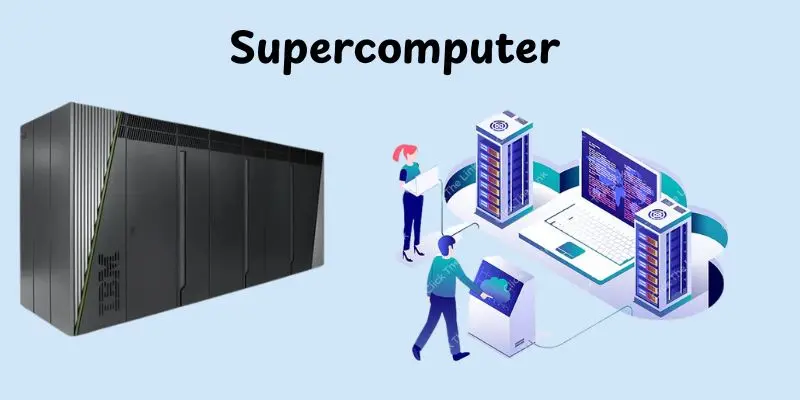
A supercomputer is a type of computer built to carry out highly complicated calculations at high speeds. It is much more powerful than a regular computer and can handle large amounts of data and perform tasks that require huge amounts of processing power. Supercomputers are used for specialized tasks like scientific research, weather forecasting and simulations.They have many processors working together, which allows them to solve problems faster than any standard computer.
Importance of Supercomputers
Supercomputers play a key role in solving some of the world’s most challenging problems. Their high power and speed make them useful in many industries.Here’s why they are so important:
- Scientific Discovery: They help researchers run complex simulations for discoveries in physics, biology and space.
- Weather Predictions: Supercomputers analyze large amounts of data to forecast weather and natural disasters.
- Medical Advancements: They help in finding new drugs and understanding diseases through detailed simulations.
- Engineering Design: Supercomputers model and test designs for things like airplanes, cars and buildings.
- National Security: They support cryptography and defense systems to ensure safety.
How Do Supercomputers Work?
Supercomputers are designed to handle complex tasks quickly by using powerful hardware and software. Here’s how they work:
- Multiple Processors: Supercomputers have many processors working together to handle different parts of a task at the same time.
- Parallel Computing: Instead of solving one problem step by step, supercomputers break it down into smaller tasks and solve them quickly.
- Large Memory:They contain huge quantities of memory for saving and easily processing big amounts of data.
- Specialized Software: Supercomputers use advanced software to manage all the tasks and processes running at once.
- High-Speed Networks: They use fast communication systems to link processors and share data quickly.
Types of Supercomputers
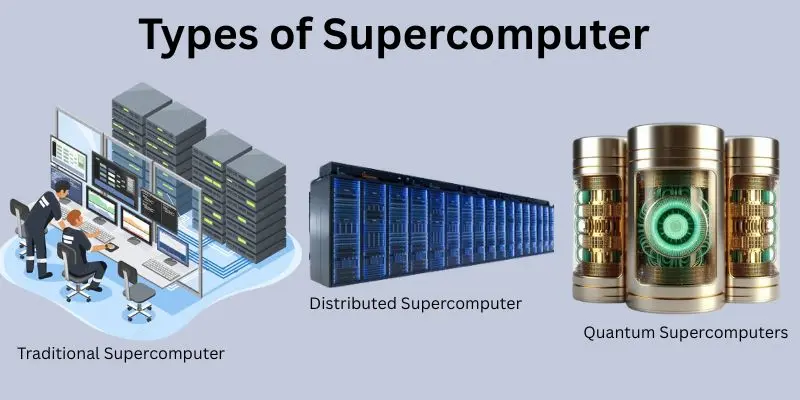
Supercomputers come in different types, each designed for specific purposes and tasks. These types different in how they are built and how they work together to solve problems.Let’s look at the main types of supercomputers:
- Traditional Supercomputers: These are powerful machines built to perform specific, high-speed calculations for tasks like simulations and weather forecasting.
- Distributed Supercomputers: These are networks of smaller computers that work together to solve problems by sharing the workload.
- Quantum Supercomputers: The newest type, these use quantum phycics to process information much faster than traditional computers, with the potential for groundbreaking applications.
Components of a Supercomputer
Supercomputers are made up of various components that work together to perform complex tasks quickly and efficiently.These components are made to handle huge volumes of data and calculations.Here are the main parts of a supercomputer:
- Processors (CPUs and GPUs): Supercomputers have multiple processors, including Central Processing Units (CPUs) and Graphics Processing Units (GPUs), to handle different types of tasks. CPUs handle general computing, while GPUs process large-scale data, especially for simulations and graphics.
- Memory: Supercomputers have large, fast memory to store and quickly access data. This memory allows the system to run multiple processes at once without slowing down.
- Storage: To handle vast amounts of data, supercomputers use high-capacity storage systems.These systems store the data used in calculations and simulations, ensuring it is accessible when needed.
- Interconnects: These are the high-speed networks that link all the components of a supercomputer, allowing them to communicate with each other quickly and efficiently.
- Cooling Systems: Supercomputers generate a lot of heat due to the intense processing. Cooling systems are used to prevent overheating and keep the components functioning properly.
- Software: Supercomputers depend on specialized software that controls the hardware and manages tasks.This software helps divide the workload, helping multiple processors to work together efficiently.
Key Uses of Supercomputers
Supercomputers play a helpful role in solving some of the world’s most complex problems. From scientific research to national security, their huge power drives innovation across various industries.Here are some key applications of supercomputers:
- Scientific Research: Supercomputers help researchers simulate complex scientific processes, like weather patterns, molecular biology and space exploration.
- Weather Forecasting: They are used to predict weather patterns, model natural disasters and track climate changes.
- Healthcare: Supercomputers aid in drug development, medical research and creating detailed models of human anatomy.
- Engineering: They provide the design and testing of structures, such as cars, airplanes and buildings, to improve safety and efficiency.
- Finance: Supercomputers analyze large sets of financial data to predict market trends, identify risks and improve decision-making.
- National Security: They are used in cryptography, security simulations and defense-related research.
- Artificial Intelligence: Supercomputers power complex AI algorithms, helping to process large amounts of data and make faster decisions.
- Energy Research: They model energy systems, study renewable energy solutions, and improve energy efficiency.
- Entertainment: Supercomputers are used in film production for rendering high-quality graphics and visual effects.
Famous Supercomputers
There are several supercomputers around the world that are recognized for their incredible power and ability to perform complex tasks. These machines are at the forefront of technology and are used in various fields like science, engineering and research.Here are some of the most famous supercomputers:
- Fugaku (Japan): Currently one of the fastest supercomputers in the world, Fugaku is used for advanced scientific simulations, like drug discovery and climate modeling.
- Summit (USA): Once the fastest supercomputer, Summit is used at Oak Ridge National Laboratory to tackle problems in physics, biology and artificial intelligence.
- Tianhe-2 (China): Known as the “MilkyWay-2,” this supercomputer is used for scientific research and to simulate real-world problems in various industries.
- Sierra (USA): Located at Lawrence Livermore National Laboratory, Sierra is used for nuclear weapons simulations and research in materials science.
- Sunway TaihuLight (China): At one point, it was the fastest supercomputer and is used for applications like climate modeling, life sciences and industrial applications.
- LUMI (Europe): Located in Finland, LUMI is designed to support research in artificial intelligence, climate change and big data analytics across Europe.
Challenges of Supercomputers
While supercomputers offer incredible power and capabilities, they also face several challenges. These challenges can affect their performance, accessibility, and environmental impact. Here are some of the main challenges supercomputers face:
- High Costs: Building, maintaining and upgrading supercomputers requires huge financial investments, making them expensive for many organizations to use.
- Energy Consumption:Supercomputers require huge amounts of power, which can result in high operating costs and environmental issues.
- Cooling Requirements: The intense heat generated by supercomputers requires advanced cooling systems, adding to the cost and complexity of maintaining these machines.
- Complex Programming: Writing software that can efficiently use the power of a supercomputer is challenging. It requires specialized knowledge and skills in parallel processing and high-performance computing.
- Limited Access: Due to their cost and size, supercomputers are not available to everyone. Access is often limited to government agencies, large research institutions, and certain industries.
- Data Management:Managing and analyzing huge volumes of data may be difficult, as it requires fast storage systems and efficient data transfer networks.
- Security Concerns: Supercomputers store and process large amounts of sensitive data, which makes them a target for cyberattacks.Ensuring their security is a constant challenge.
The Future of Supercomputers
The future of supercomputers holds huge potential, with new advancements expected to revolutionize industries and solve complex global problems.Here are some key trends for the future of supercomputers:
- Quantum Computing: The development of quantum supercomputers will allow for even faster calculations and solve problems that are currently impossible for classical computers.
- Energy Efficiency: Future supercomputers will focus on reducing energy consumption by using more sustainable technologies and improving their overall efficiency.
- Smaller, More Powerful Systems: Supercomputers will become more compact without losing their processing power, making them more accessible for different industries.
- AI Integration: Supercomputers will continue to enhance artificial intelligence, helping with tasks like deep learning, machine learning and data analysis on a much larger scale.
- Exascale Computing: Exascale supercomputers, capable of performing at least one exaflop (a quintillion operations per second), will emerge, opening new possibilities in scientific research, climate modeling and medicine.
- Wider Accessibility: As technology advances, access to supercomputing power will become more widespread, allowing more institutions and businesses to harness this computing power.
- Global Problem-Solving: Future supercomputers will be crucial in addressing global challenges such as climate change, pandemic responses and energy sustainability by simulating complex scenarios and analyzing big data.
How to Get Involved in Supercomputing
Supercomputing may sound like a complex field, but there are many ways to get started and learn about this exciting technology. Whether you’re a student, a professional, or just someone interested in the future of technology, there are accessible paths to explore supercomputing.Here’s how you can get involved:
- Learn the Basics: Begin by knowing the basic ideas of supercomputing, such as parallel processing and high-performance computing. There are many online resources and books available for beginners.
- Take Online Courses: Websites like Coursera, edX, and Udemy offer courses on supercomputing, parallel programming and high-performance computing.These can give you a deeper understanding of how supercomputers work.
- Study Computer Science or Engineering: Obtain an education in information technology, engineering, or another related field.These areas provide the foundational knowledge needed for supercomputing and high-performance computing.
- Get Hands-On with Programming: Learn programming languages commonly used in supercomputing, such as C, C++, and Fortran. Python is also used for high-performance computing tasks.
- Join Supercomputing Communities: Participate in online forums and groups related to supercomputing. Communities like the High Performance Computing (HPC) community often share resources, projects and discussions.
- Attend Conferences and Workshops: Attend events like the International Supercomputing Conference (ISC) or the Supercomputing Conference (SC) to meet experts, learn about the latest developments and network with professionals in the field.
- Internships and Research Opportunities: Look for internships or research programs that give you direct experience with supercomputing projects. Many research institutions and universities offer these opportunities.
- Explore Cloud-Based Supercomputing: Use cloud services that offer supercomputing capabilities, such as Amazon Web Services (AWS), Google Cloud, or Microsoft Azure.These platforms allow you to experiment with supercomputing without the need for massive infrastructure.
Conclusion
In this guide, we’ve covered everything you need to know about supercomputers, from how they work to their applications and future advancements. We explored the different types of supercomputers, the challenges they face and how they are shaping industries like healthcare, finance, and research.
I personally recommend diving deeper into this fascinating field. Understanding supercomputers can open up new opportunities, especially as they continue to impact the world in powerful ways. Whether you’re a student or just curious, the possibilities are endless.Keep learning, everyone—there is always something new to find in the field of supercomputing! Stay tuned for additional information!
FAQs
Supercomputers are used for tasks that require a lot of computing power, like scientific research, weather forecasting and medical simulations.They help solve complex problems faster than regular computers.They’re also used in fields like engineering, energy research, and even national security.Supercomputers make it possible to do things that would take regular computers too long to accomplish.
A supercomputer is much faster and more powerful than a regular home or office computer. It has many processors working together to solve multiple tasks at once.This lets it handle huge amounts of data quickly.
Supercomputers use many processors that work together at the same time.They split large problems into small pieces and solve them in parallel.This teamwork of parts makes them extremely fast.
Researchers, scientists and engineers at universities and research centers use supercomputers the most.Large companies and governments also use them for weather, health, and space studies.They help solve problems that need huge computing power.
Most people do not use supercomputers directly because they are expensive and complex. However, anyone can access supercomputer results through research or cloud services in some cases.Students and scientists often get access through universities and projects.



- Be Respectful
- Stay Relevant
- Stay Positive
- True Feedback
- Encourage Discussion
- Avoid Spamming
- No Fake News
- Don't Copy-Paste
- No Personal Attacks
- Be Respectful
- Stay Relevant
- Stay Positive
- True Feedback
- Encourage Discussion
- Avoid Spamming
- No Fake News
- Don't Copy-Paste
- No Personal Attacks
