What Is Hybrid Computer? A Complete and Easy Guide You’ll Actually Understand
Published: 18 Dec 2025
Many advanced systems today process real-time signals while also performing logical calculations at high speed. This often leads people to search for what Hybrid Computer is and how it fits into modern technology. In this guide, you will explore how it works, where it is used, and why it is still important in critical fields. We will also walk through its benefits, limitations, and practical examples so the topic feels clear and easy to follow from start to end.
What Is a Hybrid Computer?
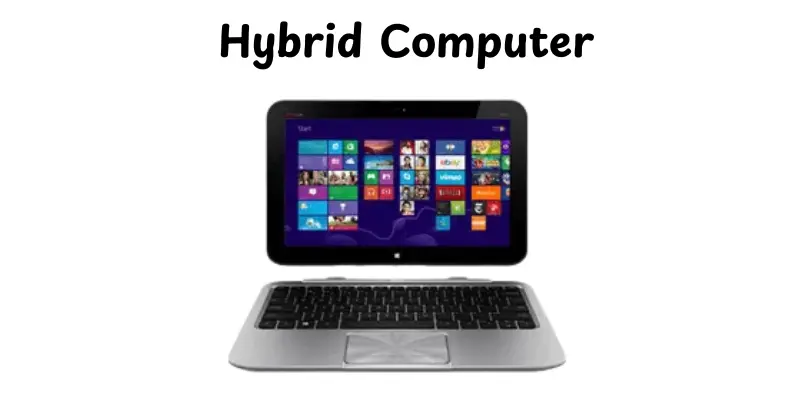
A hybrid computer is a type of computer that integrates the features of both analog and digital computers. The word hybrid stands for a mix, which shows that this computer works with continuous data as well as discrete values. It can measure physical signals like temperature or speed and also perform logical calculations at the same time. This combination allows it to deliver fast responses along with accurate results. Because of this ability, it is commonly used in systems where real-time processing is important.
Components of a Hybrid Computer
A hybrid computer works smoothly because each of its parts has a specific role. These components work together to handle both continuous data and logical operations efficiently.
- Analog Unit: Handles continuous data such as temperature, pressure, or speed from the physical environment.
- Digital Unit: Performs calculations, decision-making, and logical processing with high accuracy.
- Input Devices: Collect data from sensors or external sources and send it to the system for processing.
- Output Devices: Display or transmit the final processed results in a readable form.
- Control Unit: Manages coordination between analog and digital parts to ensure proper data flow.
- Converters (A/D and D/A): Change analog signals into digital form and digital results back into analog when needed.
How a Hybrid Computer Works
A hybrid computer works by combining two different ways of handling data in one system. It processes real-time physical signals and logical data together. This helps the system give fast and accurate results.
- Data is collected from the real world using sensors, such as heat, pressure, or speed
- The analog part handles this continuous data and prepares it for processing
- The data is converted into digital form so it can be calculated accurately
- The digital part processes the data and makes decisions or calculations
- The final result is sent to output devices in a clear and usable form
Types of Hybrid Computers
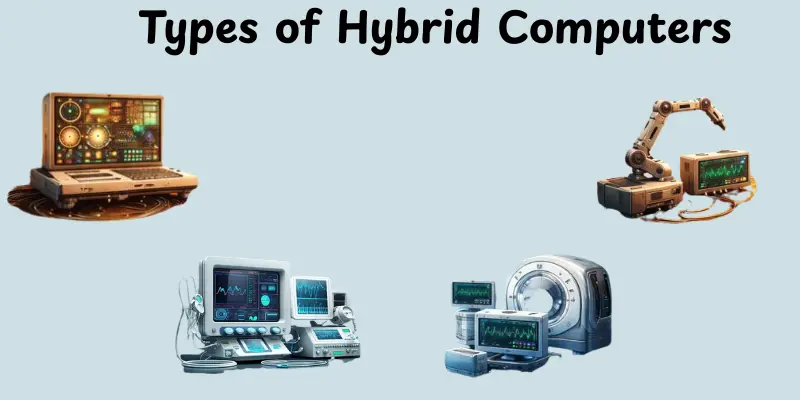
Hybrid computers are designed in different forms based on how and where they are used. Each type serves a specific purpose, from general tasks to highly specialized systems. Below are the main types explained in a simple way.
- General-Purpose Hybrid Computer: Used for multiple tasks where both measurement and calculation are needed.
- Special-Purpose Hybrid Computer: Built to perform one specific task with high accuracy.
- Embedded Hybrid Computer: Installed inside machines to control and monitor their operations.
- Medical Hybrid Computer: Used in healthcare equipment to track and analyze patient data in real time.
Applications of Hybrid Computers
Hybrid computers are used in areas where both speed and accuracy are critical. They handle real-time data while also performing precise calculations. This makes them suitable for many modern and high-risk systems.
- Medical Monitoring Systems: Track patient health signals and analyze them instantly.
- Petrol Pump Systems: Measure fuel flow and calculate billing at the same time.
- Industrial Process Control: Monitor machines and adjust operations in real time.
- Aircraft and Space Systems: Manage navigation data and support flight control decisions.
- Weather Forecasting: Collect environmental data and generate accurate predictions.
- Scientific Research: Support experiments that require fast data measurement and analysis.
- Defense Systems: Assist in radar tracking, guidance, and surveillance tasks.
Advantages and Disadvantages of Hybrid Computers
In this section, we will look at the pros and cons. This helps you understand where it works best and where it may not be the right choice. Both sides are important for a clear view.
| Advantages of Hybrid Computer |
|---|
|
| Disadvantages of Hybrid Computer |
|---|
|
Hybrid Computer in Modern Technology
Hybrid computers play an important role in today’s advanced systems where speed and accuracy are both required. They support technologies that depend on real-time data and quick decision-making. Below are key areas where they are actively used.
- Healthcare Technology: Used in patient monitoring and diagnostic machines to track real-time health data.
- Artificial Intelligence Systems: Help process live inputs while supporting accurate decision logic.
- Internet of Things Devices: Manage sensor data and system responses in smart environments.
- Industrial Automation: Control machines and production processes with real-time feedback.
- Aerospace and Defense: Support navigation, guidance, and monitoring systems for safety and precision.
Future Scope of Hybrid Computers
Hybrid computers are expected to remain important as technology continues to demand faster and more accurate systems. Their ability to work with real-time data makes them suitable for advanced and critical applications. In the coming years, their role is likely to expand in the following areas.
- Advanced Healthcare Systems: Greater use in smart monitoring and early diagnosis tools.
- Smart Manufacturing: Support for automated factories and real-time process control.
- Space and Research Programs: Increased use in simulations and mission control systems.
- Smart Cities: Help manage traffic, energy use, and public safety systems.
- High-End Scientific Research: Assist in complex experiments that require quick data response and analysis.
Conclusion
So guys, in this article, we’ve covered hybrid computers in detail. We explored its working, uses, advantages, and future relevance in a simple way. This topic becomes much clearer when you connect it with real-life examples instead of just theory. My personal recommendation is to revise the applications section to understand where it is actually used. This will help you remember the concept more easily. If this guide helped you, keep exploring related computer topics and continue learning step by step.
FAQs
Hybrid computing means using analog and digital processing in one system. For example, a heart monitoring machine measures heart signals and then analyzes them digitally. This allows fast tracking and accurate reports.
A petrol pump system is a common hybrid device. It measures fuel flow continuously and calculates the total cost digitally. Both processes happen at the same time.
Yes, hybrid computers are still used in many fields. They are common in healthcare, aviation, and industrial control systems. These areas depend on real-time data and accuracy.
No, a smartphone is not considered a hybrid computer. It works mainly as a digital computer, even though it uses sensors. The core processing remains digital.
Hybrid computers are not always better than digital computers. They are better only for tasks that need real-time measurement and fast decisions. For general use, digital computers are more practical.
Hybrid computers are expensive because of their complex design. They combine multiple systems and require special hardware. Skilled professionals are also needed to maintain them.
A medical ECG machine is often seen as the best example. It records continuous heart signals and processes them digitally. This helps doctors monitor patients accurately and quickly.



- Be Respectful
- Stay Relevant
- Stay Positive
- True Feedback
- Encourage Discussion
- Avoid Spamming
- No Fake News
- Don't Copy-Paste
- No Personal Attacks
- Be Respectful
- Stay Relevant
- Stay Positive
- True Feedback
- Encourage Discussion
- Avoid Spamming
- No Fake News
- Don't Copy-Paste
- No Personal Attacks
